14 October 2026 | Cybersecurity News | EasyLifeIT
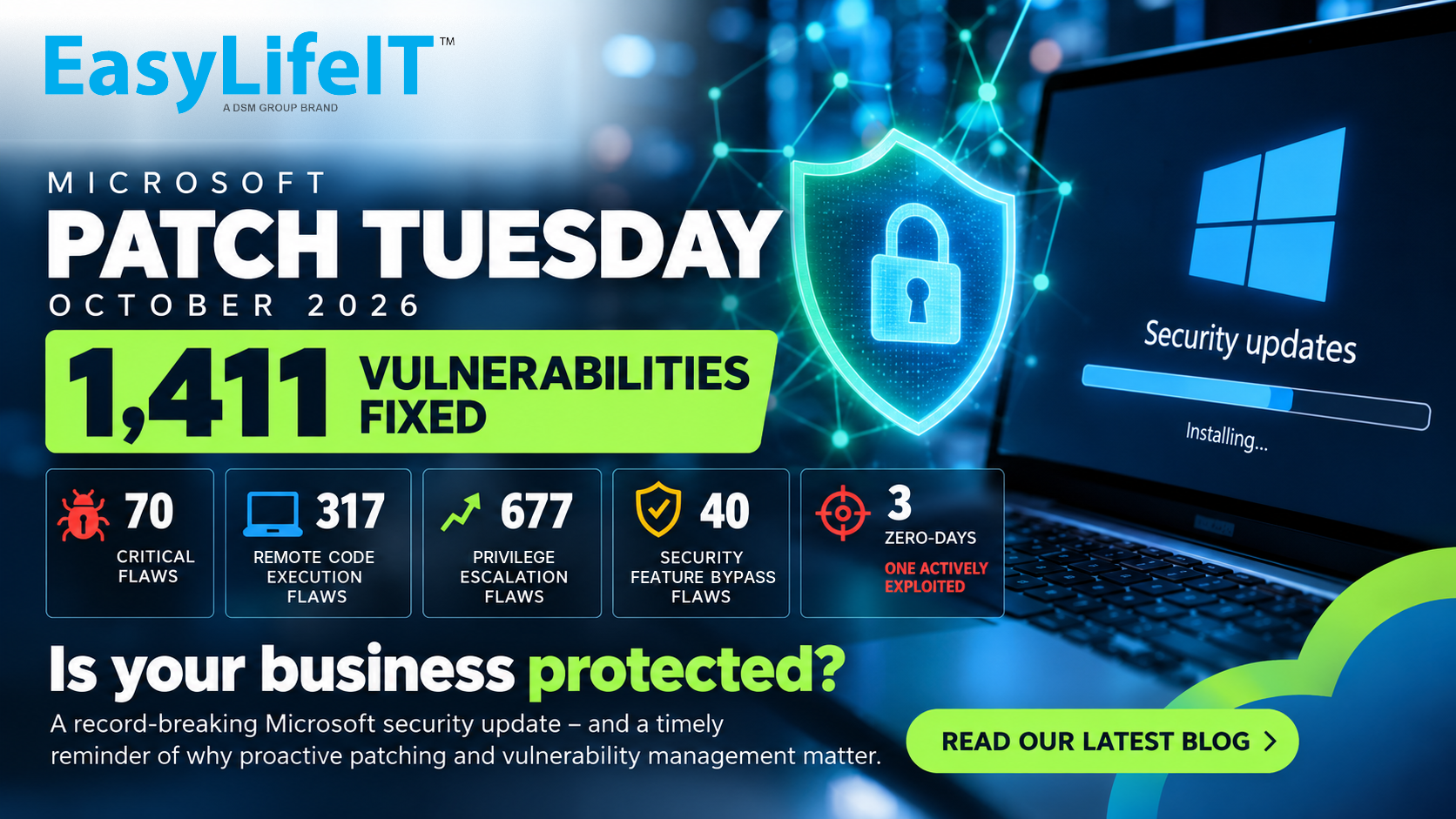
Microsoft has released one of the most significant security updates in its history, addressing a staggering 1,411 vulnerabilities, including 70 rated Critical and three zero-day vulnerabilities.
One of those zero-days is already being actively exploited by cybercriminals.
For businesses relying on Microsoft Windows, Microsoft 365 and other Microsoft technologies, this latest Patch Tuesday release is an important reminder that cybersecurity isn’t simply about installing antivirus software. It’s about understanding your exposure, managing vulnerabilities and ensuring security updates are applied before attackers can exploit them.
At EasyLifeIT, we believe effective cybersecurity should be proactive, not reactive.
October 2026 Patch Tuesday: The numbers
Microsoft’s October security release is record-breaking in scale.
| Vulnerability category | Number |
| Total vulnerabilities addressed | 1,411 |
| Critical vulnerabilities | 70 |
| Remote Code Execution (RCE) | 317 |
| Elevation of Privilege | 677 |
| Security Feature Bypass | 40 |
| Information Disclosure | 254 |
| Denial of Service | 73 |
| Spoofing | 28 |
| Zero-day vulnerabilities | 3 |
The vulnerability categories above are not exhaustive, and the severity totals overlap with them.
These figures are concerning, but the real issue isn’t simply how many vulnerabilities exist. It’s how quickly attackers can identify and exploit weaknesses in systems that remain unpatched.
A single vulnerable endpoint, server or application can potentially provide the foothold an attacker needs to compromise an organisation.
Three zero-day vulnerabilities – one already under attack
Three vulnerabilities deserve particular attention because they were either publicly disclosed or exploited before patches became available.
CVE-2026-96951 – Windows Shell Security Feature Bypass
Status: Actively exploited
This vulnerability affects Windows Shell and allows attackers to bypass a security feature associated with Mark of the Web (MotW).
Mark of the Web helps Windows identify files originating from potentially untrusted sources, such as internet downloads, so that appropriate security protections can be applied.
By bypassing this mechanism, an attacker may be able to undermine safeguards intended to protect users from malicious content.
Microsoft has confirmed active exploitation, making this an important priority for affected organisations.
CVE-2026-108398 – .NET Framework Security Feature Bypass
Status: Publicly disclosed
This vulnerability can allow an authenticated attacker to bypass Windows Defender Application Control (WDAC) restrictions.
WDAC is designed to help organisations control which applications and code can execute within their environments.
A successful exploit could allow unauthorised code to execute within a protected process, weakening an important layer of endpoint security.
For organisations relying on application control as part of their security strategy, this vulnerability deserves particular attention.
CVE-2026-92707 – MessagePack-CSharp Denial of Service
Status: Publicly disclosed
This vulnerability involves uncontrolled memory allocation and could allow an attacker to cause a denial-of-service condition in affected applications.
Although it does not necessarily provide an attacker with direct access to sensitive data, disruption to business-critical applications can still have serious operational and financial consequences.
Why remote code execution and privilege escalation matter
Two categories account for a particularly large proportion of October’s security fixes.
317 remote code execution vulnerabilities
Remote code execution vulnerabilities can allow attackers to run malicious code on affected systems when the relevant exploitation conditions are met.
Depending on the vulnerability, successful exploitation could lead to malware deployment, data theft, system compromise or disruption to business operations.
Not every RCE vulnerability can be exploited directly over the internet or without user interaction. Understanding the actual exposure of each affected system is essential.
677 elevation of privilege vulnerabilities
Privilege escalation vulnerabilities can enable attackers who already have some level of access to obtain additional permissions.
For example, an attacker who compromises a standard user account might exploit a vulnerable component to gain more powerful privileges.
This can increase the potential damage caused by an initial compromise and, in some circumstances, assist attackers in moving further through an organisation’s IT environment.
The lesson? Endpoint protection, identity security, least-privilege access and effective patch management must work together.
Windows 11 24H2 and Windows 10: Another important deadline
October’s Patch Tuesday also coincides with significant Microsoft product lifecycle changes.
As of 13 October 2026:
- Windows 11 version 24H2 Home and Pro have reached the end of support.
- Windows 10 Enterprise LTSB 2016 has also reached the end of support.
- Windows 11 version 23H2 Enterprise and Education editions are approaching their November 2026 end-of-support deadline.
Businesses should review their Windows estate to identify devices running unsupported or soon-to-be-unsupported operating system versions.
An unsupported operating system can create additional security and compliance risks, particularly when new vulnerabilities are discovered and routine security updates are no longer available.
Eligible extended security update programmes may provide temporary protection for certain products, but they should not replace a longer-term upgrade strategy.
Why simply enabling automatic updates isn’t enough
Automatic updates are important, but they are only one component of effective vulnerability management.
A business may have automatic Windows updates enabled and still have significant exposure because:
- Devices are switched off, disconnected or rarely used.
- Updates fail to install successfully.
- Servers require scheduled maintenance windows and controlled restarts.
- Third-party applications contain vulnerabilities outside Windows Update.
- Legacy systems cannot support the latest security updates.
- Vulnerabilities exist in network equipment, firewalls or other infrastructure.
- There is no central reporting to confirm that patches have actually been applied.
Perhaps most importantly, an update being available is not the same as an update being successfully installed and verified.
Without centralised monitoring and reporting, businesses may have little visibility of their true security position.
Microsoft’s new approach to vulnerability prioritisation
With such a large number of vulnerabilities to address, deciding what to patch first becomes increasingly important.
For October 2026, Microsoft has introduced an experimental approach called risk cohorts, grouping related vulnerabilities to help organisations better understand areas of exposure.
These include vulnerabilities affecting Windows storage and backup, Office documents and email clients, Windows graphics components, kernel privilege boundaries and deployment services.
This approach reinforces an important cybersecurity principle:
Not all vulnerabilities carry the same level of risk to every organisation.
A vulnerability affecting an internet-facing production server may require a different response from one affecting an isolated test machine.
Good vulnerability management considers severity, known exploitation, exposure, business criticality and the security controls already in place.
What should businesses do now?
EasyLifeIT recommends that organisations take the following steps:
1. Identify affected systems
Maintain an accurate inventory of endpoints, servers, applications and operating system versions.
2. Prioritise actively exploited vulnerabilities
Review Microsoft’s security advisories and prioritise relevant vulnerabilities with evidence of active exploitation.
3. Deploy and verify security updates
Apply updates using an appropriate change management process and confirm successful installation.
4. Review unsupported operating systems
Identify devices that are no longer receiving standard security updates and establish an upgrade or replacement plan.
5. Assess wider vulnerabilities
Don’t focus exclusively on Microsoft products. Review third-party software, network infrastructure and other business-critical systems.
6. Monitor continuously
Cybersecurity isn’t a once-a-month exercise. New vulnerabilities emerge constantly, and businesses need ongoing visibility of their exposure.
How EasyLifeIT can help
At EasyLifeIT, we help businesses take control of their IT security through practical, proactive management.
Our managed IT and cybersecurity services can help organisations improve their security posture through:
Managed IT Support
Proactive management, monitoring and maintenance of business IT environments.
Patch Management
Coordinated deployment and monitoring of security updates across supported devices and systems.
Vulnerability Management as a Service (VMaaS)
Ongoing vulnerability identification, risk-based prioritisation, reporting and remediation support to help reduce exposure.
Cyber Essentials and Cyber Essentials Plus
Helping organisations understand the technical controls required for certification and improve their overall cybersecurity practices.
Endpoint and Cybersecurity Protection
Layered security measures designed to reduce the likelihood and impact of cyberattacks.
Don’t wait for a vulnerability to become a security incident
Microsoft’s October 2026 Patch Tuesday demonstrates the sheer volume and complexity of vulnerabilities that modern businesses must manage.
While 1,411 security fixes make an attention-grabbing headline, the more important question is:
Do you know which vulnerabilities currently affect your business – and whether they’re being addressed?
If the answer is no, now is a good time to review your approach.
Talk to EasyLifeIT about managed patching, vulnerability management and improving your organisation’s cybersecurity posture.
Contact us to find out how we can help.
Sources: Microsoft Security Response Center and BleepingComputer, October 2026. Vulnerability counts and exploitation status reflect information available at publication and may be updated.
EasyLifeIT | Making business IT easier, safer and more manageable.